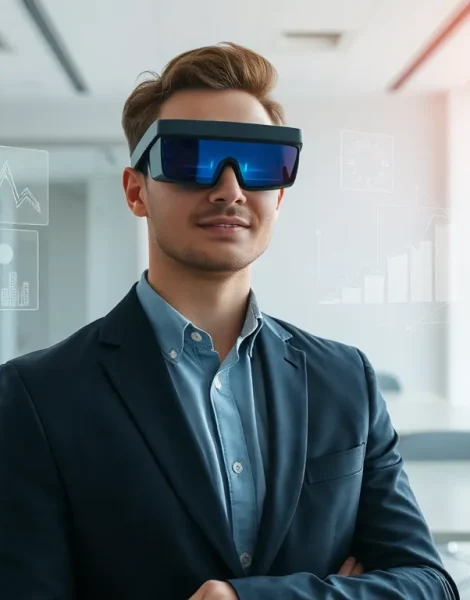
Augmented reality (AR) overlays digital content onto the physical world. It blends virtual elements, like images, sounds, and text, with real-world surroundings in real time. Unlike virtual reality, which creates entirely artificial environments, augmented reality enhances what users already see.
This technology has moved far beyond novelty filters on social media. Today, augmented reality powers navigation apps, surgical procedures, retail experiences, and industrial training programs. Understanding what augmented reality is and how it functions helps explain why major tech companies are investing billions in its development.
Table of Contents
ToggleKey Takeaways
- Augmented reality overlays digital content onto the physical world in real time, enhancing what users already see rather than replacing it.
- AR relies on three core components—sensors, processing power, and display technology—to seamlessly blend virtual elements with real surroundings.
- Common types include marker-based, markerless, projection-based, and superimposition-based AR, each serving different use cases.
- Augmented reality is transforming industries like retail, healthcare, education, gaming, and manufacturing by solving real-world problems.
- Current limitations include hardware requirements, battery drain, privacy concerns, and high development costs.
- The AR market is projected to reach $340 billion by 2028 as tech giants develop lightweight glasses designed for everyday use.
How Augmented Reality Works
Augmented reality relies on three core components: sensors, processing power, and display technology.
Sensors and Cameras
Devices use cameras and sensors to capture information about the user’s environment. These sensors detect surfaces, measure distances, and track movement. GPS, accelerometers, and gyroscopes help determine the device’s position and orientation.
Processing
Once the device gathers environmental data, software processes this information. AR algorithms identify surfaces, recognize objects, and calculate where to place digital content. This processing happens almost instantly, which creates the illusion that virtual elements exist in physical space.
Display
The final step involves projecting digital content onto a screen or lens. Smartphones display augmented reality through their screens. AR headsets and glasses project images directly into the user’s field of view. Some systems use projectors to cast digital elements onto physical surfaces.
The entire process happens in milliseconds. A user points their phone at a table, and an AR app places a virtual lamp on that surface. The lamp stays anchored to the table even as the user moves around it. This seamless integration is what makes augmented reality feel natural.
Types of Augmented Reality
Not all augmented reality experiences work the same way. Developers use different approaches depending on their goals.
Marker-Based AR
Marker-based AR uses visual triggers, like QR codes or specific images, to activate digital content. When a camera recognizes a marker, the system displays associated AR elements. This type offers high accuracy because markers provide clear reference points.
Markerless AR
Markerless AR doesn’t need predetermined triggers. Instead, it uses location data, object recognition, or surface detection to place content. Pokemon GO is a famous example. The game places virtual creatures in real-world locations using GPS and camera data.
Projection-Based AR
This type projects light onto physical surfaces. Some systems detect user interaction with these projections. For instance, a projected keyboard on a desk can register when someone taps the virtual keys.
Superimposition-Based AR
Superimposition AR replaces part of the original view with a digital overlay. IKEA’s app demonstrates this well. Users can replace an empty corner with a virtual couch to see how it looks in their space.
Each type of augmented reality serves different purposes. Marker-based works great for packaging and print materials. Markerless suits location-based experiences. The choice depends on the specific use case.
Common Applications of Augmented Reality
Augmented reality has found practical uses across many industries.
Retail and E-Commerce
Shoppers can try on clothes, test makeup, or preview furniture without leaving home. Brands like Sephora and Warby Parker use AR to let customers see products on themselves before buying.
Healthcare
Surgeons use augmented reality to view patient data during procedures. Medical students practice on AR simulations before working with real patients. Some AR tools help patients understand their conditions through 3D visualizations.
Education and Training
Textbooks come alive when students scan pages to reveal 3D models. Mechanics learn to repair engines by following AR guides overlaid on actual equipment. This hands-on approach improves retention compared to traditional methods.
Gaming and Entertainment
Pokemon GO brought augmented reality to mainstream attention in 2016. Since then, AR games and interactive experiences have multiplied. Museums use AR to add context to exhibits. Concert venues create immersive visual experiences for audiences.
Manufacturing and Maintenance
Workers receive step-by-step AR instructions while assembling products or performing repairs. Boeing uses augmented reality to help technicians install wiring in aircraft, reducing errors and training time.
These applications show how augmented reality solves real problems. It bridges information gaps and makes complex tasks more accessible.
Benefits and Limitations of AR
Augmented reality offers significant advantages, but it also faces real constraints.
Benefits
Enhanced Learning
AR creates interactive experiences that improve understanding. People retain information better when they can manipulate 3D objects rather than just read about them.
Improved Decision-Making
Seeing a virtual product in context helps consumers make confident purchases. Businesses report fewer returns when customers use AR before buying.
Increased Efficiency
Workers complete tasks faster with AR guidance. Real-time instructions reduce errors and eliminate the need to consult separate manuals.
Accessibility
AR can provide visual aids, translations, and navigation assistance for people with different needs.
Limitations
Hardware Requirements
High-quality augmented reality demands powerful processors and capable cameras. Not all devices deliver smooth AR experiences.
Battery Consumption
AR apps drain batteries quickly. Extended use on mobile devices isn’t always practical.
Privacy Concerns
AR devices that constantly scan surroundings raise questions about data collection and surveillance.
Development Costs
Building quality AR applications requires specialized skills and significant investment. Smaller businesses may struggle to justify the expense.
These limitations haven’t stopped augmented reality’s growth. But they do explain why adoption isn’t universal yet.
The Future of Augmented Reality
Augmented reality is heading toward deeper integration with daily life.
Apple, Google, Meta, and other tech giants are developing AR glasses designed for all-day wear. These devices aim to replace smartphones for many tasks. Instead of pulling out a phone, users would see notifications, directions, and messages directly in their field of vision.
5G networks will improve AR performance by reducing latency. Cloud-based processing will let lightweight glasses handle complex AR tasks without bulky onboard hardware.
The augmented reality market is projected to reach $340 billion by 2028, according to industry analysts. This growth reflects confidence that AR will become as common as touchscreens are today.
Spatial computing, where digital and physical environments blend seamlessly, represents the next frontier. Future AR systems will understand context, recognize objects automatically, and respond to natural gestures and voice commands.
Education, healthcare, and remote work stand to change dramatically. Imagine attending a meeting where remote colleagues appear as holograms in your office. Or learning anatomy by examining a life-size virtual heart floating in front of you.
Augmented reality’s future depends on solving current limitations. Smaller hardware, longer battery life, and better privacy protections will determine how quickly mass adoption happens.