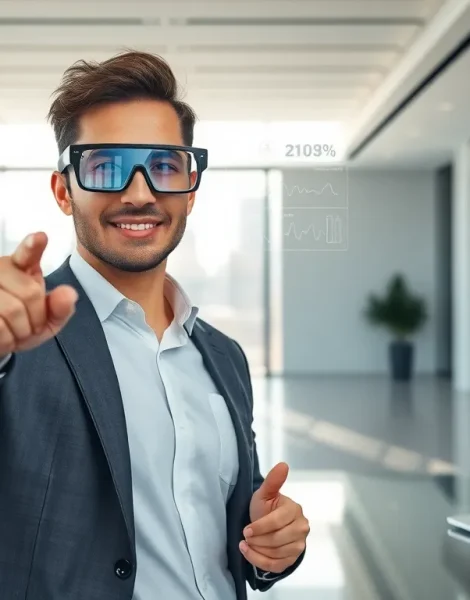
Augmented reality (AR) changes how people interact with the world around them. This technology overlays digital information onto physical environments in real time. Users see enhanced versions of reality through smartphones, tablets, or specialized glasses.
AR has moved far beyond gaming and entertainment. Businesses now use augmented reality for training, retail, healthcare, and manufacturing. The global AR market reached $42.4 billion in 2023 and continues to grow rapidly. Understanding how this technology works, and where it’s heading, matters for anyone interested in tech’s next major shift.
Table of Contents
ToggleKey Takeaways
- Augmented reality overlays digital content onto the physical world in real time, keeping users grounded in their actual surroundings unlike virtual reality.
- The global AR market reached $42.4 billion in 2023 and is projected to grow to $597.5 billion by 2030.
- Industries like retail, healthcare, manufacturing, and education use augmented reality to improve efficiency, training, and customer experiences.
- AR technology works through sensors, computer vision, and real-time rendering to seamlessly anchor digital objects to physical spaces.
- Current challenges include hardware costs, privacy concerns, and user adoption barriers, but advances in smart glasses and 5G are accelerating progress.
- AI integration will make augmented reality smarter by automatically recognizing objects and providing contextual information.
What Is Augmented Reality?
Augmented reality adds digital elements to a live view of the physical world. Unlike virtual reality (VR), which creates entirely artificial environments, AR keeps users grounded in their actual surroundings. The technology simply adds layers of computer-generated content on top.
Think about trying on sunglasses through your phone’s camera before buying them online. That’s augmented reality at work. The glasses appear on your face in real time, letting you see how they look without visiting a store.
AR systems work through three core components:
- Sensors and cameras collect data about the user’s environment
- Processing software interprets that data and determines where to place digital objects
- Displays project the combined view back to the user
The result feels seamless. Digital objects appear anchored to physical spaces, moving naturally as users shift their perspective. This creates experiences that feel intuitive rather than artificial.
How Augmented Reality Technology Works
Augmented reality relies on several technologies working together. Each piece plays a specific role in creating convincing digital overlays.
Tracking and Positioning
AR devices must understand their position in physical space. They use GPS, accelerometers, gyroscopes, and cameras to track movement and orientation. Simultaneous Localization and Mapping (SLAM) algorithms help devices build 3D maps of environments while tracking their own location within them.
Computer Vision
Cameras capture the surrounding environment. Computer vision algorithms analyze these images to identify surfaces, objects, and spatial relationships. This analysis tells the AR system where digital content can logically appear.
Rendering and Display
Once the system knows where to place digital objects, it renders them in real time. Graphics processors generate images that match the lighting, scale, and perspective of the physical environment. The display then combines these generated images with the camera feed.
Smartphones handle all this processing internally. Dedicated AR glasses distribute the workload between the device and cloud servers. Either approach delivers augmented reality experiences that respond instantly to user movements.
Common Applications of Augmented Reality
Augmented reality has found practical uses across many industries. Here are the most significant applications today.
Retail and E-Commerce
Retailers use AR to let customers preview products before purchase. IKEA’s app places virtual furniture in homes. Sephora’s tool shows how makeup looks on a user’s face. These augmented reality features reduce return rates and increase buyer confidence.
Healthcare and Medicine
Surgeons use AR to overlay patient data during procedures. Medical students practice on virtual patients. AccuVein’s AR device helps nurses locate veins for blood draws, reducing missed attempts by 45%.
Manufacturing and Maintenance
Factory workers wear AR glasses that display assembly instructions hands-free. Technicians see repair guides overlaid directly onto equipment. Boeing reported 25% faster wiring production after implementing augmented reality assistance.
Education and Training
AR brings textbooks to life with 3D models and interactive content. Corporate training programs use augmented reality simulations to teach procedures safely. Learners retain information better through hands-on AR experiences than traditional methods.
Gaming and Entertainment
Pokémon GO introduced millions to augmented reality in 2016. The game generated over $6 billion in revenue. Snapchat and Instagram filters represent another form of AR entertainment used daily by hundreds of millions.
Benefits and Challenges of AR Adoption
Augmented reality offers clear advantages, but organizations face real obstacles when implementing it.
Key Benefits
Enhanced Learning: AR makes abstract concepts tangible. Students can examine 3D models of molecules or historical artifacts. Workers learn procedures faster with visual guides.
Improved Decision-Making: Customers see products in context before buying. Architects show clients how buildings will look on actual sites. Better visualization leads to better choices.
Increased Efficiency: Hands-free instructions speed up complex tasks. Workers don’t flip through manuals or watch videos. Augmented reality puts the right information in their line of sight.
Significant Challenges
Hardware Limitations: Current AR glasses remain expensive and often bulky. Battery life limits extended use. Smartphone AR drains batteries quickly too.
Development Costs: Building quality augmented reality experiences requires specialized skills. Content creation takes time. Smaller businesses struggle to justify the investment.
Privacy Concerns: AR devices with cameras raise questions about surveillance and data collection. Users worry about what information companies capture during augmented reality sessions.
User Adoption: Some people experience motion sickness or eye strain. Others simply prefer traditional interfaces. Changing behavior takes time.
The Future of Augmented Reality
Augmented reality technology continues to advance rapidly. Several trends will shape its development over the next decade.
Apple’s Vision Pro and Meta’s Quest 3 signal major tech companies’ commitment to AR. These devices combine augmented and virtual reality capabilities. They point toward a future where digital and physical worlds blend more completely.
Smart glasses will become lighter, more powerful, and more affordable. Companies like Ray-Ban and Meta already sell stylish AR-enabled eyewear. Within five years, augmented reality glasses may look indistinguishable from regular frames.
5G networks enable faster data transfer and lower latency. This allows AR applications to offload processing to cloud servers. Users get more powerful augmented reality experiences on lighter, cheaper devices.
AI integration will make AR smarter. Systems will recognize objects, understand context, and provide relevant information automatically. Imagine pointing your glasses at a restaurant and instantly seeing reviews, wait times, and menu highlights.
The augmented reality market is projected to reach $597.5 billion by 2030. That growth reflects how deeply AR will integrate into daily life. From work to entertainment to education, augmented reality will change how people access and interact with information.