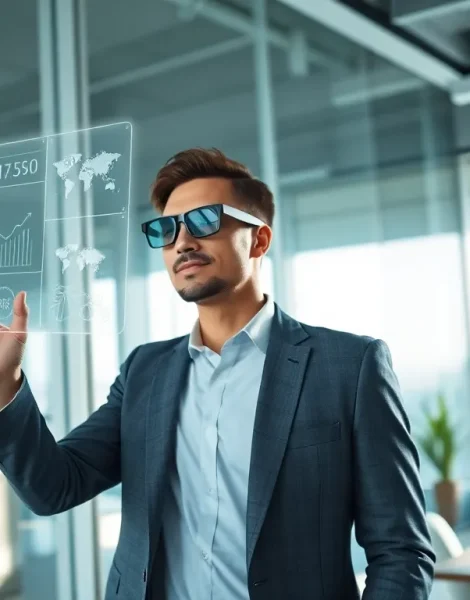
Augmented reality trends 2026 will reshape how people interact with digital content. The technology has moved beyond novelty apps and gaming filters. AR now sits at the center of enterprise strategy, consumer products, and daily life.
Industry analysts project the global AR market will exceed $100 billion by 2026. This growth stems from lighter hardware, smarter AI integration, and expanded use cases across industries. Companies that ignored AR five years ago now race to build AR-first experiences.
This article examines the key augmented reality trends 2026 will bring. From next-generation wearables to spatial computing breakthroughs, here’s what businesses and consumers should expect.
Table of Contents
ToggleKey Takeaways
- Augmented reality trends 2026 will be driven by sleeker, lighter AR glasses under 100 grams that look like regular eyewear.
- AI-powered features like real-time object recognition, generative 3D content, and personalized experiences will transform how users interact with AR.
- Retail, healthcare, and education lead AR adoption with virtual try-ons, surgical overlays, and immersive 3D learning experiences.
- Spatial computing and the AR Cloud will create persistent, shared digital layers mapped onto the real world.
- The global AR market is projected to exceed $100 billion by 2026, pushing companies to build AR-first strategies.
- Privacy concerns around always-on AR cameras will force regulators to establish clearer guidelines in 2026.
Advancements in AR Hardware and Wearables
AR hardware has long struggled with a fundamental problem: bulky devices that people don’t want to wear. That’s changing fast.
In 2026, augmented reality trends point toward sleeker, lighter wearables that look more like regular glasses than sci-fi props. Apple, Meta, and Samsung have all announced or released AR glasses that weigh under 100 grams. These devices pack improved displays, longer battery life, and better field-of-view specs.
MicroLED and waveguide display technologies drive much of this progress. MicroLED panels deliver brighter images while consuming less power. Waveguide optics project digital content onto transparent lenses without the thick, heavy components of earlier designs.
Processor improvements matter too. Qualcomm’s Snapdragon AR chipsets now handle complex visual processing on-device. This reduces latency and eliminates the need for a tethered smartphone or computer.
Consumer adoption hinges on comfort and style. Nobody wants to wear clunky headgear in public. The augmented reality trends 2026 brings include AR glasses that pass as fashion accessories. Several luxury eyewear brands have partnered with tech companies to design frames people actually want on their faces.
Battery technology remains a challenge. Most AR glasses still last only 4-6 hours on a single charge. But, advances in solid-state batteries and wireless charging cases should extend usage times significantly by late 2026.
AI-Powered AR Experiences
Artificial intelligence transforms what AR can do. The augmented reality trends 2026 emphasizes most involve AI working behind the scenes.
Real-time object recognition has improved dramatically. AR apps now identify thousands of objects instantly and overlay relevant information. Point your glasses at a plant, and you’ll see its species, care instructions, and local nurseries that sell it. Look at a building, and you’ll get its history, current businesses, and upcoming events.
Generative AI adds another layer. Users can describe what they want to see, and AI creates 3D content on the spot. Imagine telling your AR glasses “show me how this room would look with mid-century modern furniture” and watching virtual sofas and tables appear around you.
Natural language processing makes AR interfaces more intuitive. Voice commands replace awkward hand gestures and tiny buttons. Users simply speak their requests, and the AI interprets and executes them.
Personalization stands out among augmented reality trends 2026 delivers. AI learns user preferences and adjusts AR content accordingly. A sports fan sees scores and stats when walking past a stadium. A foodie sees restaurant reviews and menu highlights when passing eateries.
Computer vision algorithms now handle occlusion, the ability to make digital objects appear behind real ones. This creates far more believable AR experiences. Virtual content no longer floats awkwardly in front of everything.
AR in Retail, Healthcare, and Education
Three industries lead AR adoption, and augmented reality trends 2026 show their investments paying off.
Retail
Retailers use AR to solve e-commerce’s biggest weakness: customers can’t try before they buy. Virtual try-on features let shoppers see how clothes, glasses, makeup, and furniture look before purchasing. Return rates drop significantly when customers preview products in AR first.
In-store AR adds value too. Shoppers point their devices at products to see reviews, ingredient lists, and comparison prices. Some stores deploy AR navigation to guide customers directly to items on their shopping lists.
Healthcare
Surgeons use AR overlays during procedures. The technology displays patient scans, vital signs, and surgical guidance directly in the surgeon’s field of view. This keeps critical information visible without looking away from the patient.
Medical training benefits from augmented reality trends 2026 brings. Students practice procedures on AR-generated anatomy without needing cadavers. They can repeat difficult techniques until they achieve proficiency.
Patient care improves through AR-assisted rehabilitation. Physical therapy apps guide patients through exercises and correct their form in real time.
Education
Classrooms transform when textbook diagrams become 3D models students can examine from every angle. Biology students explore virtual cells. History students walk through ancient civilizations. Chemistry students watch molecular reactions unfold.
The augmented reality trends 2026 will showcase include AR field trips. Students visit locations they could never reach physically, the surface of Mars, the depths of the ocean, the inside of a volcano.
The Rise of Spatial Computing and AR Cloud
Spatial computing represents the next frontier for augmented reality trends 2026. This approach treats physical space as a computing platform. AR devices understand where they are, what surrounds them, and how to place digital content that persists over time.
The AR Cloud makes this possible. Think of it as a digital layer mapped onto the real world. When someone places a virtual note on a park bench, others with AR devices can see it too. Information attaches to locations rather than individual screens.
Major tech companies invest heavily in building this shared AR infrastructure. Google, Microsoft, and Niantic have all developed spatial mapping systems. These platforms store detailed 3D maps of public spaces, enabling persistent and shared AR experiences.
Privacy concerns accompany these advances. AR devices with always-on cameras raise questions about surveillance and data collection. The augmented reality trends 2026 brings will force regulators and companies to address these issues more directly.
Developers gain new tools for spatial computing. SDKs and APIs let creators build AR experiences that span multiple users and persist indefinitely. A sculpture placed in a public square today could remain visible to AR users for years.
The line between physical and digital continues to blur. Spatial computing and AR Cloud development rank among the most significant augmented reality trends 2026 will advance. They lay the groundwork for experiences that previous AR technology couldn’t support.