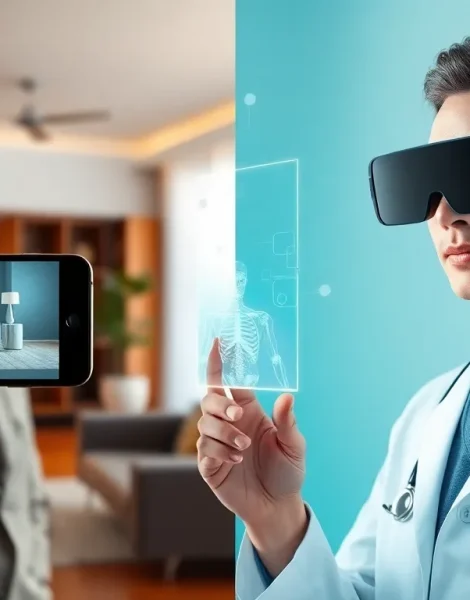
Augmented reality examples are everywhere, from trying on virtual sunglasses to practicing surgery without a scalpel. This technology overlays digital content onto the physical world, and it’s changing how people shop, learn, heal, and play. Unlike virtual reality, which creates an entirely new environment, augmented reality (AR) enhances what already exists. A smartphone camera becomes a magic lens. A classroom becomes an interactive lab. A living room becomes a gaming arena.
The global AR market is projected to reach $97.76 billion by 2028, according to industry research. That growth reflects real adoption across industries. Retailers use AR to reduce returns. Surgeons use it to plan operations. Teachers use it to make history come alive. This article explores the most compelling augmented reality examples across five key sectors: retail, healthcare, education, and entertainment.
Table of Contents
ToggleKey Takeaways
- Augmented reality examples span retail, healthcare, education, and entertainment, with the global AR market projected to reach $97.76 billion by 2028.
- Retailers like IKEA, Sephora, and Nike use AR to reduce returns and help customers visualize products before purchasing.
- Healthcare professionals use augmented reality to locate veins, overlay imaging data during surgery, and train medical students with 3D anatomical models.
- AR transforms education by turning abstract concepts into interactive 3D experiences, improving engagement and retention for students.
- Pokémon GO introduced mainstream audiences to augmented reality examples in gaming, generating over $1 billion in its first year.
- Most people already carry AR-capable smartphones, making the technology accessible without expensive headsets.
What Is Augmented Reality?
Augmented reality blends digital elements with the real world in real time. Users view their surroundings through a device, typically a smartphone, tablet, or AR headset, while the software adds images, sounds, or data to what they see.
AR differs from virtual reality in one critical way: it doesn’t replace reality. Instead, it builds on it. Point a phone at a restaurant menu, and AR might display calorie counts floating next to each dish. Look at a mountain range through AR glasses, and labels could identify each peak.
The technology relies on several components working together:
- Cameras and sensors capture the user’s environment
- Processing power analyzes the scene and determines where to place digital objects
- Display systems show the combined real and virtual view
- Input methods let users interact with AR content through touch, voice, or gestures
Augmented reality examples span a wide range of complexity. Some are simple, like Snapchat filters that add dog ears to selfies. Others are sophisticated, like Microsoft’s HoloLens displaying 3D holograms for industrial workers.
The appeal of AR lies in its accessibility. Most people already carry an AR-capable device in their pocket. No special headset required. That low barrier to entry has accelerated adoption and spawned countless augmented reality examples across industries.
Retail and Shopping Experiences
Retail offers some of the most practical augmented reality examples in daily life. AR helps shoppers make better decisions and helps stores reduce costly returns.
IKEA’s Place app lets customers see furniture in their homes before buying. Users point their phone at a room, select a couch or bookshelf, and the app displays a life-sized 3D model in position. It accounts for scale, lighting, and shadows. That blue sofa might look great online, but seeing it in your actual living room changes everything.
Cosmetics brands have embraced AR with virtual try-on features. Sephora’s Virtual Artist app analyzes a user’s face and applies digital makeup, lipstick, eyeshadow, foundation, in real time. L’Oréal offers similar technology. Customers can test dozens of shades in minutes without touching a single product.
Warby Parker uses AR to let shoppers try on glasses virtually. The app maps facial features and displays frames as if the user were wearing them. It’s not perfect, but it’s close enough to narrow down choices before visiting a store.
Nike’s AR features measure feet using a smartphone camera. The app scans both feet and recommends the right size for each shoe model. Nike reported that this tool reduced returns from sizing issues significantly.
These augmented reality examples solve real problems. They reduce buyer uncertainty, cut return rates, and create engaging experiences that keep customers coming back. AR in retail isn’t a gimmick anymore, it’s becoming standard practice.
Healthcare and Medical Training
Healthcare provides some of the most impactful augmented reality examples. AR is helping doctors treat patients more effectively and training the next generation of medical professionals.
AccuVein uses AR to project a map of veins onto a patient’s skin. Nurses and phlebotomists can see exactly where veins are located, making blood draws and IV insertions easier. The company claims their device increases first-stick success rates by 3.5 times. For patients with difficult veins, that’s a meaningful improvement.
Surgeons use AR during operations to overlay imaging data, CT scans, MRIs, directly onto the patient’s body. Instead of glancing at a separate monitor, they see the internal anatomy superimposed on the surgical site. This approach helps with tumor removal, spinal surgery, and other precise procedures.
Medical schools have integrated AR into training programs. Students can view 3D anatomical models that they can rotate, zoom, and explore. Case Western Reserve University partnered with Cleveland Clinic to create an AR anatomy curriculum using Microsoft HoloLens. Students study the human body in three dimensions without cadavers.
Physical therapy benefits from AR as well. Apps guide patients through exercises and track their movements in real time. The software can correct form and measure progress over weeks or months.
These augmented reality examples in healthcare share a common thread: they make invisible information visible. Whether it’s a hidden vein or the position of a tumor, AR brings critical data into the field of view exactly when clinicians need it.
Education and Learning Applications
Education has embraced AR as a tool for engagement and understanding. The best augmented reality examples in learning make abstract concepts concrete.
Google Expeditions pioneered AR field trips. Students could view volcanoes, hurricanes, or DNA molecules right in their classroom. A teacher would guide the experience while students explored 3D objects from every angle. The program reached millions of students before transitioning to other platforms.
Anatomy apps bring biology lessons to life. Instead of flat diagrams, students see beating hearts, expanding lungs, and firing neurons in 3D. They can peel away layers of muscle to examine bones. This interactive approach helps visual learners grasp complex systems.
History becomes more engaging with AR. Apps can overlay historical scenes onto present-day locations. Stand at a battlefield, and AR might show troop movements. Visit ancient ruins, and see buildings reconstructed as they once stood.
Language learning uses AR for immersion. Apps label objects in the user’s environment with foreign words. Point a phone at a chair, and see “la silla” floating above it. This contextual learning reinforces vocabulary more effectively than flashcards alone.
AR also supports students with learning differences. Interactive 3D models can help students who struggle with traditional texts. The technology offers multiple ways to engage with the same material.
Augmented reality examples in education demonstrate a shift from passive learning to active exploration. Students don’t just read about photosynthesis, they watch it happen. That difference matters for retention and understanding.
Gaming and Entertainment
Gaming delivered the augmented reality examples that introduced most people to the technology. Pokémon GO launched in 2016 and became a cultural phenomenon. Players walked through real neighborhoods catching virtual creatures that appeared on their phone screens. The game generated over $1 billion in revenue within its first year and proved that AR could attract mainstream audiences.
The success of Pokémon GO inspired other location-based AR games. Harry Potter: Wizards Unite let fans cast spells and encounter magical creatures. Ingress built a global community around capturing virtual portals at real-world landmarks. These games turned physical movement into gameplay mechanics.
AR enhances traditional entertainment too. Sports broadcasts overlay statistics, player names, and graphics onto live footage. The yellow first-down line in American football broadcasts is an early augmented reality example that viewers now take for granted.
Museums and attractions use AR to enrich visitor experiences. The Smithsonian offers AR features that animate exhibits. Theme parks integrate AR into rides and interactive experiences. Visitors can see characters and effects that blend with physical sets.
Social media platforms have made AR creation accessible to everyone. Snapchat, Instagram, and TikTok offer tools for users to build and share their own AR filters. Some creators have built careers around designing popular effects.
Live events incorporate AR for enhanced experiences. Concerts might display visual effects visible only through an app. Sporting events offer AR replays and stats. These augmented reality examples show how entertainment continues to evolve through the technology.